.png)

From Rosaries to Ampullae: How Groningen Students Helped Map Religious Heritage in Leeuwarden
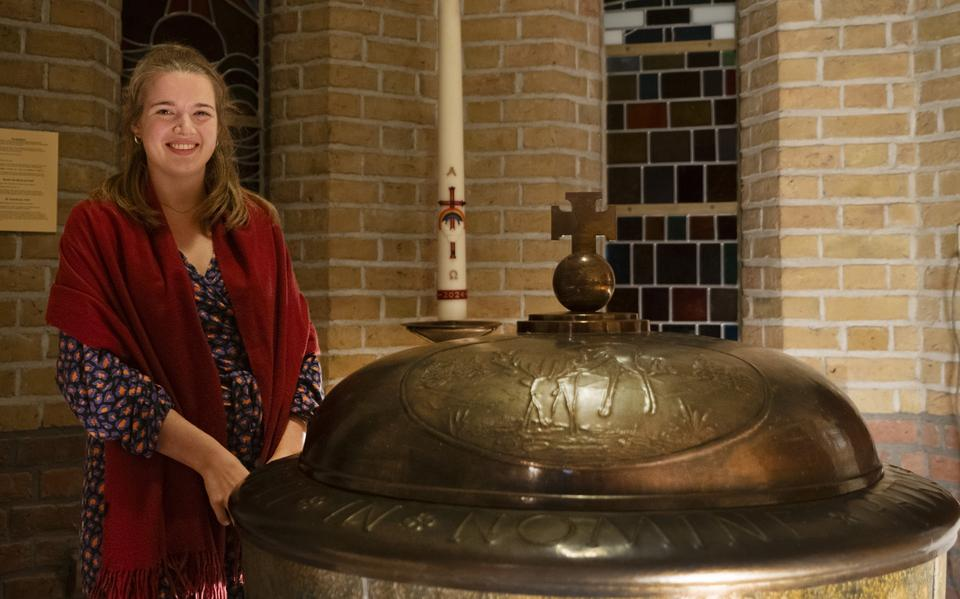
Hannah Zondervan at the baptismal font from 1952. Photo: Jaap Schaaf
A recent newspaper feature from the Netherlands highlighted a project that captures the spirit of RELIC very well: students from the University of Groningen researching religious heritage objects in the Dominican Church of Leeuwarden.
The article presents a remarkable local collection of around 650 religious heritage objects, described as the largest collection of religious heritage in the Diocese of Friesland and Groningen. What makes the story especially relevant for RELIC is the role of students, who carried out object based research and helped bring this heritage into public conversation.
This is exactly the kind of work RELIC prepares students to do.
Heritage as research, interpretation and public engagement
The newspaper piece shows students examining different objects from the collection and interpreting their historical and religious significance. The selected examples include a baptismal font, a monstrance and a portrait linked to the church’s history.
What stands out is the way heritage is approached, not as a static collection but as a set of objects connected to communities, rituals, memory and identity. Students are not only identifying artefacts, they are helping explain why these objects matter and how they tell stories about social and religious life across time.
This reflects a core principle of the RELIC programme: heritage work requires critical interpretation, contextual understanding and the ability to communicate with wider audiences.
Why this matters for RELIC
At RELIC, all students begin their journey in Groningen, where they build a shared foundation in critical heritage studies, religion, museums and public engagement. The Leeuwarden example is a strong illustration of how that academic training can connect with real collections and local institutions.
Projects like this help students develop key competences that are central to RELIC:
object based analysis and interpretation
historical and cultural contextualisation
public communication of heritage knowledge
collaboration with heritage institutions and communities
ethical awareness in representing religious heritage
It also shows something very important about professional training in heritage. Learning becomes much stronger when students work with real materials, real places and real stakeholders.
A local case with global relevance
Although this project is rooted in Leeuwarden, the questions it raises are international. How do we preserve religious heritage when institutions change? How do we make collections accessible to new generations? How do we keep knowledge alive when objects are no longer regularly used in their original context?
These are exactly the kinds of questions RELIC addresses across its mobility pathways in Europe, Asia and Latin America.
From Groningen to Cyprus, from Guanajuato to Barcelona, RELIC students learn that heritage governance is always about more than preservation. It is also about interpretation, inclusion and responsibility.
RELIC in practice
This story is a strong example of the RELIC approach in action before the programme even begins formally for many future applicants. It shows what happens when academic training meets field based heritage work.
For prospective students, it offers a clear preview of the RELIC experience:rigorous study, interdisciplinary thinking and meaningful engagement with heritage in the public domain.
If you want to help shape how heritage is understood, protected and shared, this is the kind of work you can expect to be part of in RELIC.


Comentarios